
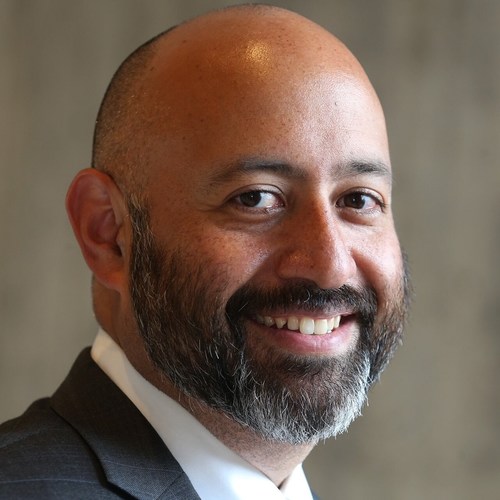
Interview with Marty Martinez
Marty Martinez took the reins as CEO of Reach Out and Read after serving as Boston’s chief of Health and Human Services during the COVID-19 pandemic. He’s a passionate believer in reading as an essential health benefit for children and families.
Founded in 1989 to help families make reading a part of their routines, Reach Out and Read focuses on pediatric clinics – a highly-trusted source of information and advice. With a presence in every state, Reach Out and Read has 6,000 program sites that provide 6.6 million books a year for use during well-child visits to specially-trained pediatricians. In 2020, Reach Out and Read enhanced its training to promote reading in infancy and its critical importance to Early Relational Health.
We sat with Marty to learn more about Reach Out and Read and the value of reading to children from their earliest days.
What does the Reach Out and Read model look like and what makes it unique?
We embed books and early literacy into well-child visits for children under age 5. We train clinicians, pediatricians, family physicians, and nurse practitioners to incorporate our books into those visits, and to model for parents how to use the books. A child is given a new book to take home at each visit, so kids accumulate, on average, 14 books by the time they turn 5.
A parent might ask, “My infant’s only 3 months old, what am I supposed to do with this book?” And the clinician will explain, “The baby can see the words, and when you move the book, their eyes will follow.” For older children, clinicians talk to parents about using words and sounds and building on them together with their children. The books also serve as a developmental assessment tool. Can a child hold the book? What does the child do when they touch the book’s pages?
The uniqueness of our model is that we are baked into the place where most children get their healthcare — the well-child visit. We reach 24% of children under 5 in the US, and our goal is for the program to be universal. And, because our model specifically involves clinicians, this helps parents see reading’s connection to wellness, health, and development.
What do young children gain from having parents or caregivers read to them?
There’s strong evidence that children who are read to are more likely to have early word development and a love of reading.
Then there’s also what you can feel and trust. When I read to my 5-year-old son, we both feel the bond it creates. Does he know more words and letters because we’re reading together? Sure. Is he confident that things sound a certain way? Sure. But when he’s sitting on my lap and we’re reading aloud, we’re also developing an emotional connection. Books build better brains, which will make you ready for kindergarten. But reading together is also where relational health is being built.
How does relational health fit with Reach Out and Read’s strategy?
At Reach Out and Read, we see books as the tools to create moments that matter. Without that book, without that connection over the words, we can’t get to the moments when relational health is being built. That is reflected in the new path we are on as an organization – training clinicians to emphasize bonding and relational health during reading. We want all children to have healthy, positive experiences – and relationships are core to that. Each book is a stepping-stone to building better brains and better relationships.
These are completely linked as an organization and that’s our strategy: The power of reading is in what it gives you both in your brain and in your heart.
A recent study of 100,000 parents identified beneficial effects of the Reach Out and Read program. What are key findings?
The study showed that parents and caregivers who were exposed to our model were 27% more likely to read to their children every day. It also showed that behaviors that support engagement in our model contributed to that outcome, including encouraging kids to be involved in the book, identifying things in the pictures with kids, and asking questions about the book.
The study reaffirmed that our model can change behavior. It underscored that, if you integrate the model, it leads to parents being more likely to read to their child. Having a study of this magnitude allows us to continue to scream on the top of the hill that what we do makes a big difference in the lives of families.